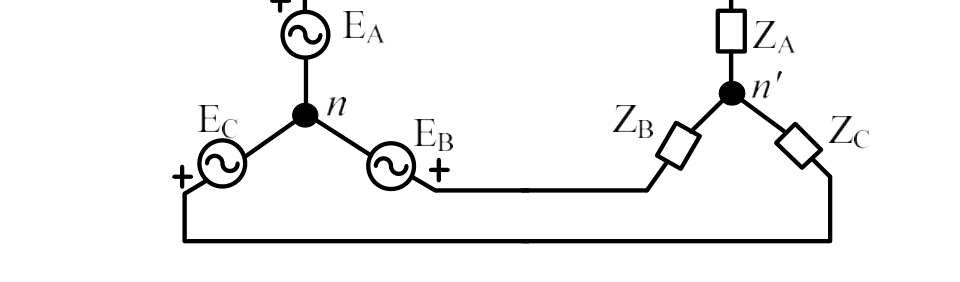
In the circuit shown below, a three-phase star-connected unbalanced load is connected to a balanced three-phase supply of $100\sqrt3$ V with phase sequence $ABC$. The star connected load has $Z_A=10\ \Omega$ and $Z_B=20\angle60^\circ\ \Omega$. The value of $Z_C$ in $\Omega$, for which the voltage difference across the nodes $n$ and $n'$ is zero, is
The phase voltages are $E_A=100\angle0^\circ$, $E_B=100\angle-120^\circ$, $E_C=100\angle120^\circ$. The neutral shift is zero when $\frac{E_A}{Z_A}+\frac{E_B}{Z_B}+\frac{E_C}{Z_C}=0$. The first two currents are $10\angle0^\circ$ and $5\angle-180^\circ=-5$, so $\frac{E_C}{Z_C}=-5$ and $Z_C=\frac{100\angle120^\circ}{5\angle180^\circ}=20\angle-60^\circ$.
More Transient response of DC and AC networks, sinusoidal steady-state analysis, resonance, two port networks, balanced three phase circuits, star-delta transformation, complex power and power factor in AC circuits questions
GATE 2022 EE Q27– An inductor having a Q-factor of 60 is connected in series with a capacitor having a…
GATE 2022 EE Q28– The network shown below has a resonant frequency of 150 kHz and a bandwidth of 600 Hz. The…
GATE 2022 EE Q34– Two balanced three-phase loads, as shown in the figure, are connected to a 1003 V,…
GATE 2021 EE Q24– In the given circuit, the value of capacitor C that makes current I=0 is F.
GATE 2021 EE Q30– The Bode magnitude plot for the transfer function V o(s)V i(s) of the circuit is as shown.…
GATE 2021 EE Q31– A signal generator having a source resistance of 50\ is set to generate a 1 kHz sinewave.…