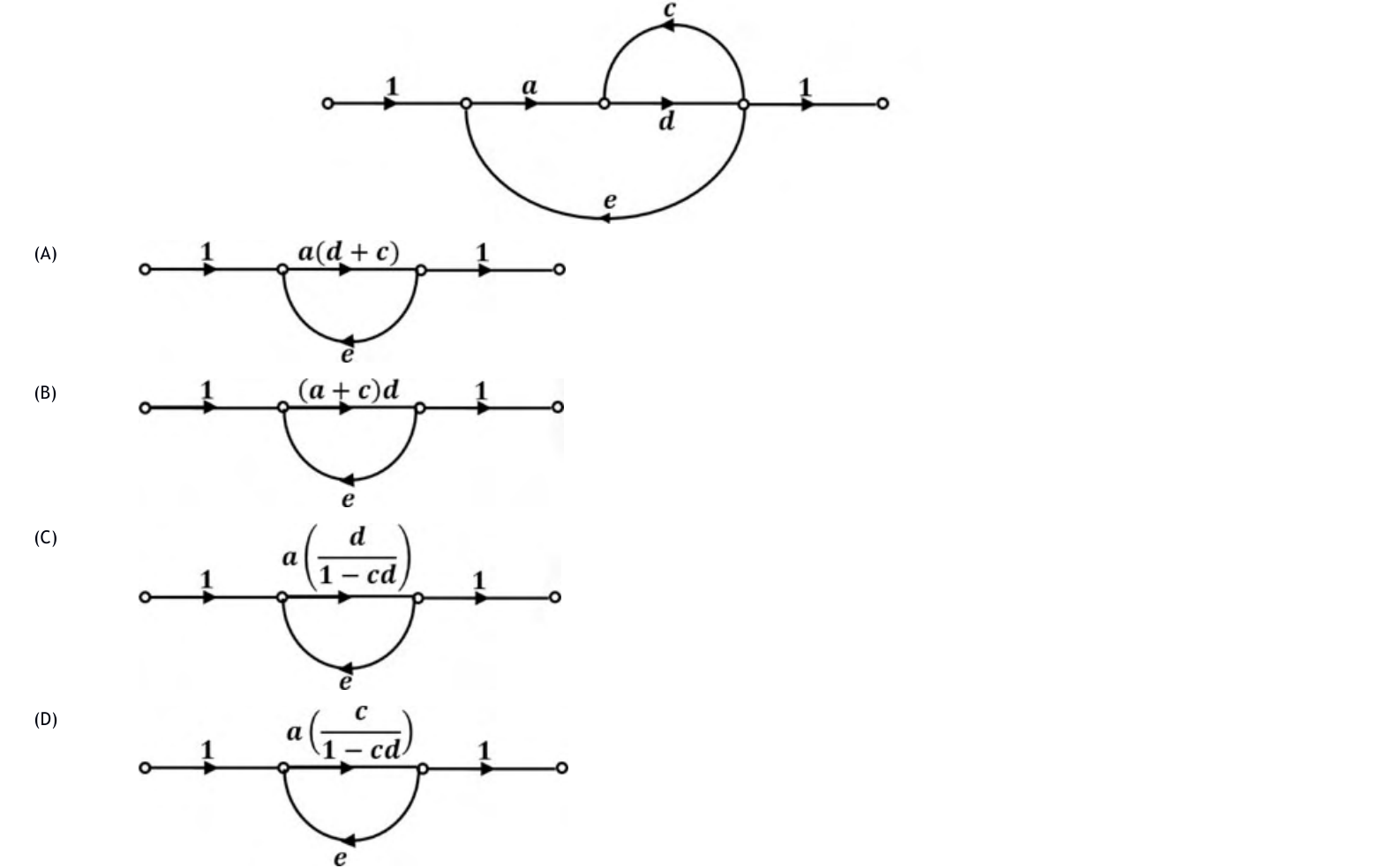
The self-loop $c$ at the node after $d$ gives that node a loop gain of $cd$, so the forward path through it is multiplied by $\frac{1}{1-cd}$. Combining with the gains $a$ and $d$ along the forward path gives $\frac{ad}{1-cd}$, with the outer feedback branch $e$ unchanged, which is graph (C).
More Mathematical modelling and representation of systems, Feedback principle, Transfer function, Block diagrams and Signal flow graphs questions
GATE 2020 EE Q44– Consider a permanent magnet dc (PMDC) motor which is initially at rest. At t=0, a dc…
GATE 2015 EE Q35– For the signal-flow graph shown in the figure, which one of the following expressions is…
GATE 2015 EE Q63– The transfer function of a second order real system with a perfectly flat magnitude…
GATE 2015 EE Q64– Find the transfer function Y(s)X(s) of the system given below.
GATE 2017 EE Q42– In the system whose signal flow graph is shown in the figure, U 1(s) and U 2(s) are…
GATE 2015 EE (EE2) Q65– The system obeys x 1=2x 1+x 2+u, x 2=-2x 1+u, y=3x1. Its zero-state transfer Y(s)/U(s) is