GATE 2017 EC – Question 21
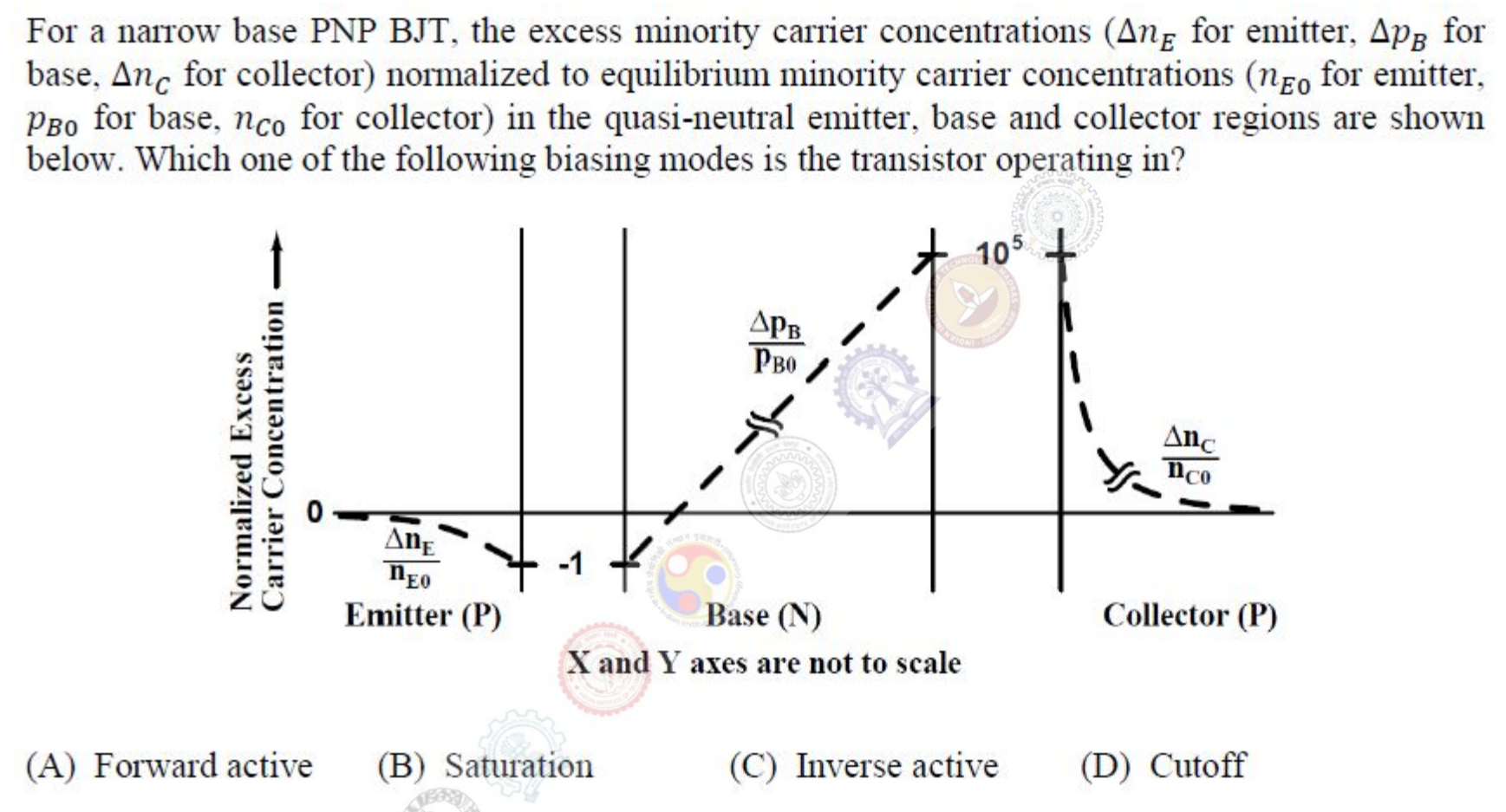
For a narrow base PNP BJT, the excess minority carrier concentrations ($\Delta n_E$ for emitter, $\Delta p_B$ for base, $\Delta n_C$ for collector) normalized to equilibrium minority carrier concentrations ($n_{E0}$ for emitter, $p_{B0}$ for base, $n_{C0}$ for collector) in the quasi-neutral emitter, base and collector regions are shown below. Which one of the following biasing modes is the transistor operating in?
Practise this question in The GATE Grind →
Show answer and explanation
Correct answer: (C) Inverse active
Explanation
At the emitter side of the base the excess is $-1$, which means the minority carrier concentration there is zero. This happens when the emitter-base junction is reverse biased. At the collector side the excess is very large and positive, which happens when the collector-base junction is forward biased. With the emitter junction reversed and the collector junction forward, the transistor is in the inverse active mode.