The GATE Grind

GATE 2026 CH – Question 7

General Aptitude · Spatial Aptitude: Spatial Reasoning and Visualization · 2 marks · Multiple choice

A paper shown in Panel I is folded along the dashed lines (- - -) to construct a cube. The shaded regions shown in Panel I appear on the outer surface of the cube. Referring to cubes shown in Panel II, which one of the options is correct?
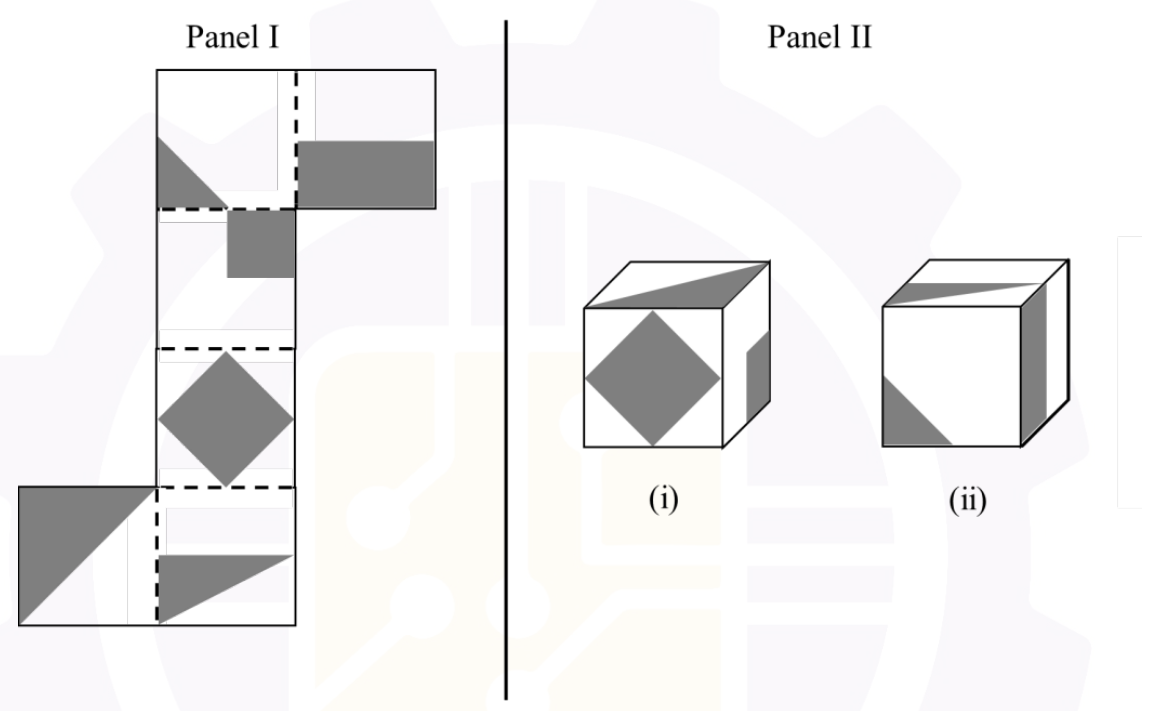
Panel I is a net of six squares: a column of four squares with two more squares attached, one to the right of the top square and one to the left of the bottom square. From the top: the first has a small shaded right triangle in its lower left corner, and the square on its right has its lower half shaded. The second square has a quarter square shaded in its upper right corner. The third has a large shaded diamond. The fourth has a shaded triangle in its lower left half with its top edge at the middle height, and the square on its left has its upper left half shaded along the diagonal. Panel II shows two cubes. Cube (i) has the diamond on the front, a half-face triangle on the top and a small shaded square in the lower back corner of the right face. Cube (ii) has a small triangle in the lower left corner of the front, a thin triangle on the top and a vertical band on the front half of the right face.
  1. Only (i) can correspond to the unfolded cube in Panel I.
  2. Only (ii) can correspond to the unfolded cube in Panel I.
  3. Both (i) and (ii) can correspond to the unfolded cube in Panel I.
  4. Neither (i) nor (ii) can correspond to the unfolded cube in Panel I.

Practise this question in The GATE Grind →

Show answer and explanation

Correct answer: (A) Only (i) can correspond to the unfolded cube in Panel I.

Explanation

Fold the net with the diamond square as the front. The square above it becomes the top, and the square on the right of the top square of the column becomes the right face. Turning the cube so that the diamond is still in front, the square on the left of the bottom square comes to the top, with its diagonal half shaded, and the square with the quarter shaded corner comes to the right, with the quarter in the lower back corner. That is exactly cube (i). For cube (ii), the front must be the top square of the column (small triangle), the top must be the bottom square of the column (thin triangle, which matches), but the right face must then be the square with the lower half shaded, which would appear as a band along the bottom of the right face and not as a vertical band on its front half. So only (i) is possible.