GATE 2023 CH – Question 5
A line of symmetry is defined as a line that divides a figure into two parts in a way such that each part is a mirror image of the other part about that line.
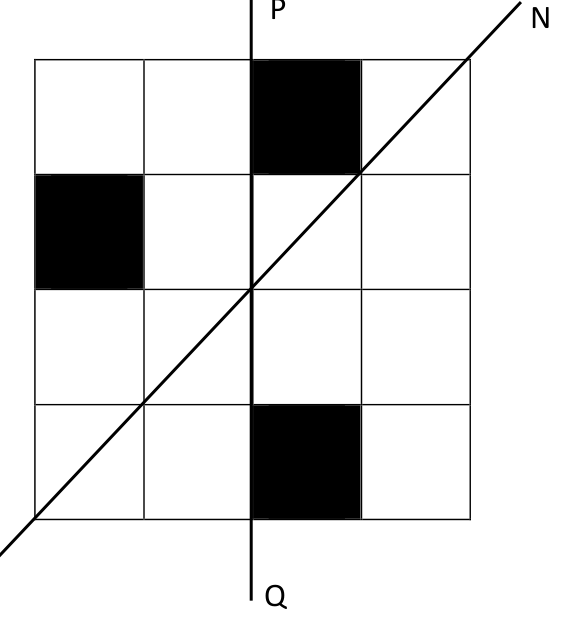
The given figure consists of 16 unit squares arranged as shown. In addition to the three black squares, what is the minimum number of squares that must be coloured black, such that both PQ and MN form lines of symmetry? (The figure is representative)
Practise this question in The GATE Grind →
Show answer and explanation
Correct answer: (C) 5
Explanation
Number the columns 1 to 4 from the left and the rows 1 to 4 from the bottom. The black squares are (3, 4), (1, 3) and (3, 1). Reflecting in the vertical line PQ takes $(c, r)$ to $(5 - c, r)$ and reflecting in the diagonal MN takes $(c, r)$ to $(r, c)$. Applying both reflections repeatedly to (3, 4) gives the eight squares (3, 4), (2, 4), (4, 3), (4, 2), (1, 3), (1, 2), (3, 1), (2, 1). All three given black squares are in this set, and all eight must be black for both lines to be symmetry lines. So $8 - 3 = 5$ more squares are needed.