GATE 2023 EE – Question 44
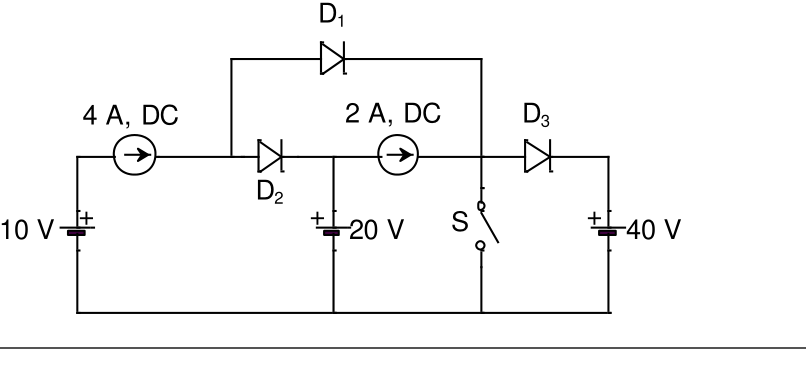
All the elements in the circuit shown in the following figure are ideal. Which of the following statements is/are true?
Practise this question in The GATE Grind →
Show answer and explanation
Correct answer: (B) When switch $S$ is ON, $D_1$ conducts and both $D_2$ and $D_3$ are reverse biased; (C) When switch $S$ is OFF, $D_1$ is reverse biased and both $D_2$ and $D_3$ conduct
Explanation
$S$ ON: the switch grounds the node at the cathode of $D_1$ and the anode of $D_3$. The 4 A source must return through $D_1$ to ground, holding its anode at 0 V, which is below the 20 V battery node, so $D_2$ is reverse biased. $D_3$ has its anode at 0 V and its cathode at 40 V: reverse biased. So only $D_1$ conducts (B). $S$ OFF: the 2 A source pushes current into the node at the anodes of $D_3$; it can only flow through $D_3$ into the 40 V battery, so $D_3$ conducts and that node sits at 40 V. The 4 A source flows through $D_2$ into the 20 V battery, so the anode of $D_1$ is at 20 V, less than 40 V: $D_1$ is reverse biased and $D_2$, $D_3$ conduct (C).