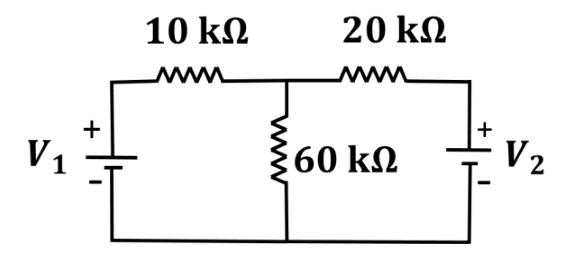
Let the central voltage be V. Kirchhoff’s current law gives (V−V₁)/10+(V−V₂)/20+V/60=0, with resistances in kilohms. Multiplying by sixty gives 10V=6V₁+3V₂, so V=(3/10)(2V₁+V₂). Power is V²/60 kΩ and is therefore proportional to (2V₁+V₂)², C.
More Network Theorems questions
GATE 2023 BM Q46– In the shown 10 V circuit, what load resistance R gives maximum power dissipation in R?
GATE 2022 BM Q52– Find the magnitude of current gain Iload/Iin in the shown dependent-source circuit, to two…
GATE 2021 BM Q13– Three resistors are connected to ideal sources as shown: current source 1.2 A, voltage…
GATE 2021 BM Q39– In the shown bridge, Vₛ=100 V, R₁=30 Ω,R₂=60 Ω,R₃=90 Ω,R₄=45 Ω,R₅=30 Ω. Find current…
GATE 2020 BM Q41– Find the nearest power dissipated in the 3 Ω resistor of the shown circuit, with 2 A…
GATE 2026 BM Q29– Find the Thevenin voltage in volts at the RLoad terminals of the shown 15 V, three-100 Ω…