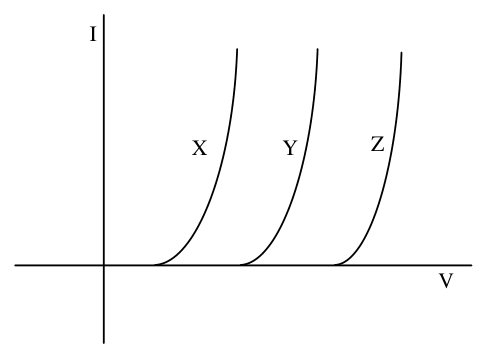
The room-temperature I–V curves of diodes made from materials X,Y,Z are shown. They are uniformly doped and otherwise identical. With material band gaps $E_{gX},E_{gY},E_{gZ}$, which relation holds?
For otherwise comparable junctions, a larger band gap reduces intrinsic carrier concentration and reverse saturation current. A larger forward voltage is then required to obtain the same current.
At any fixed positive current on the plotted curves, X requires the least voltage, Y an intermediate voltage and Z the greatest. Thus the band gaps rise in the same order: **$E_{gX}<E_{gY}<E_{gZ}$, C**.
More P-N Junction and Semiconductor Devices questions
GATE 2016 EC (EC3) Q21– The figure shows the band diagram of a metal–oxide–semiconductor structure. Its surface…
GATE 2016 EC (EC3) Q22– The shown solar-cell I–V curve is measured under uniform illumination of 100\ mW/cm2. The…
GATE 2016 EC (EC3) Q48– Two unit-area MOS capacitors are shown. Figure I uses dielectric X of thickness t 1=1 nm…
GATE 2026 EC Q14– Consider carrier transport in a Zener diode in the breakdown region. Which is the dominant…
GATE 2026 EC Q25– Consider a p-n junction diode when it is forward biased with 2 V. Which of the following…
GATE 2026 EC Q29– Figure shows the output characteristics of two different Bipolar Junction Transistors…