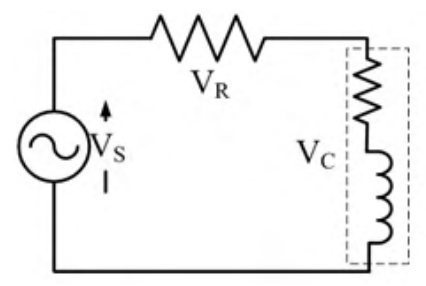
A resistance and a coil are connected in series across 100 V rms, 50 Hz. The figure shows the coil’s resistance and inductance. Which rms pair (VR,VC) is plausible, in volts?
**Official disposition: marks to all (MTA).** The source key does not require one particular option.
For the coil modeled as r+jX with X>0, VR is in phase with current while VC leads it by θ between 0° and 90°. They satisfy $100^2=V_R^2+V_C^2+2V_RV_C\cos\theta$.
The pair 60,90 gives cosθ=(10000−3600−8100)/(10800)<0, incompatible with an ordinary passive coil. The pair 60,80 requires θ=90°, corresponding to a lossless coil. The pairs summing to 100 require θ=0°. The nonideal drawing and ambiguous intended idealizations make a unique plausible choice problematic; preserve MTA rather than forcing one.
More Transient response of DC and AC networks, sinusoidal steady-state analysis, resonance, two port networks, balanced three phase circuits, star-delta transformation, complex power and power factor in AC circuits questions
GATE 2016 EE (EE2) Q22– Load voltage and current are v(t)=100 t V and i(t)=10( t-60)+23 t+55 t A. Average load…
GATE 2016 EE (EE2) Q45– The shown two-port has z11=40 Ω,z12=60 Ω,z21=80 Ω,z22=100 Ω. Find average power delivered…
GATE 2016 EE (EE2) Q46– In the balanced three-phase 50 Hz circuit, each delta inductor has L=10 mH. Find each star…
GATE 2015 EE (EE2) Q54– The circuit has V 1=1000 V, V 2=100-120 V, V 3=100120 V. Find phasor current i in amperes.
GATE 2015 EE (EE2) Q55– A symmetric ±15 V square wave of 50% duty and period 0.4π ms drives series RLC with R=5…
GATE 2026 EE Q26– A single-phase voltage source v s=325(250t) V delivers a current, i=12(250t)+9(2150t) A to…