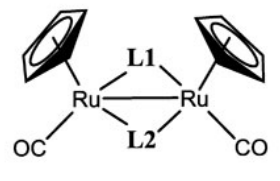
For the neutral Ru–Ru complex shown, which bridging L1,L2 combination makes both metals obey the 18-electron rule? Candidate ligands are H⁻, NO⁻, MeCH²⁻ and CO. Ru atomic number is 44.
For the symmetric neutral pair with two Cp⁻ groups and a bridging alkylidene of charge −2, each Ru is formally +2 (d⁶). At each Ru count d⁶ + Cp (6e) + terminal CO (2e) + the shared alkylidene (2e per metal) + bridging CO (1e per metal) + Ru–Ru bond (1e) = 18. Therefore L1 = MeCH²⁻ and L2 = CO, C. Replacing the alkylidene by hydride changes both oxidation-state balance and the donation count.
More Organometallics: 18-Electron rule; metal-alkyl, metal-carbonyl, metal-olefin and metal-carbene complexes and metallocenes. Fluxionality in organometallic complexes. Types of organometallic reactions. Homogeneous catalysis – Hydrogenation, hydroformylation, methanol to acetic acid process, olefin metathesis and Wacker oxidation. Heterogeneous catalysis – Fischer-Tropsch reaction, Ziegler-Natta polymerization. questions
GATE 2020 CY Q47– The shown cationic η⁷-cycloheptatrienyl molybdenum tricarbonyl reacts with NaOMe at 0°C to…
GATE 2019 CY Q40– What product forms when Mn₂(CO)₁₀ reacts with Br₂?
GATE 2019 CY Q41– Which hapticity representation is appropriate for W(Cp)₂(CO)₂, where Cp is…
GATE 2024 CY Q11– Among the following, the compound with the lowest CO stretching frequency is
GATE 2024 CY Q31– The number of metal-metal bond(s) in the complex [(5-Cp)Mo(CO) 2] 2 is x and in [(5-Cp)…
GATE 2024 CY Q38– The heptacity of allyl and Cp and the ligation mode of NO in the thermodynamically stable…