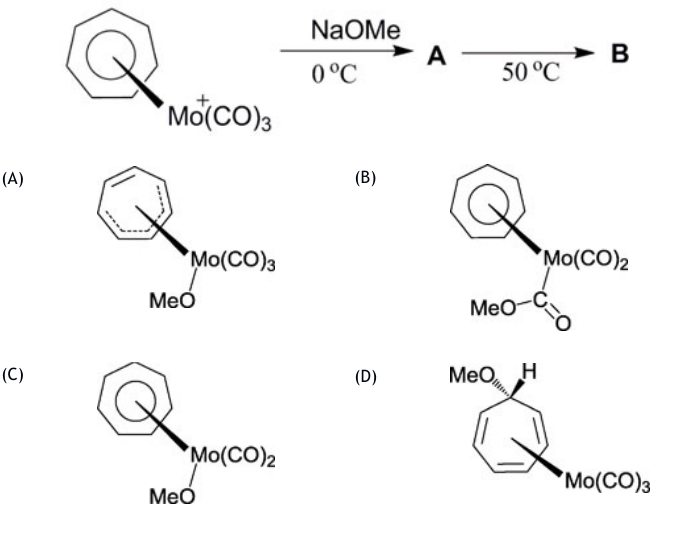
The shown cationic η⁷-cycloheptatrienyl molybdenum tricarbonyl reacts with NaOMe at 0°C to give A, then warms to 50°C to give B. Select B. Mo atomic number is 42.
Methoxide is a nucleophile and attacks the electron-deficient coordinated cycloheptatrienyl ring. Ring addition converts one carbon to an sp³ site and lowers the ring’s hapticity while maintaining the metal carbonyl framework. On warming, the stable ring-substituted cycloheptatriene complex has methoxy on the face opposite the metal coordination. This gives D, with C–OMe and C–H stereochemistry at the saturated ring carbon; it is not simple methoxide substitution on molybdenum or attack retained on a carbonyl ligand.
More Organometallics: 18-Electron rule; metal-alkyl, metal-carbonyl, metal-olefin and metal-carbene complexes and metallocenes. Fluxionality in organometallic complexes. Types of organometallic reactions. Homogeneous catalysis – Hydrogenation, hydroformylation, methanol to acetic acid process, olefin metathesis and Wacker oxidation. Heterogeneous catalysis – Fischer-Tropsch reaction, Ziegler-Natta polymerization. questions
GATE 2019 CY Q40– What product forms when Mn₂(CO)₁₀ reacts with Br₂?
GATE 2019 CY Q41– Which hapticity representation is appropriate for W(Cp)₂(CO)₂, where Cp is…
GATE 2024 CY Q11– Among the following, the compound with the lowest CO stretching frequency is
GATE 2024 CY Q31– The number of metal-metal bond(s) in the complex [(5-Cp)Mo(CO) 2] 2 is x and in [(5-Cp)…
GATE 2024 CY Q38– The heptacity of allyl and Cp and the ligation mode of NO in the thermodynamically stable…
GATE 2024 CY Q39– In the following reactions, the structures of I, II, and III, respectively, are