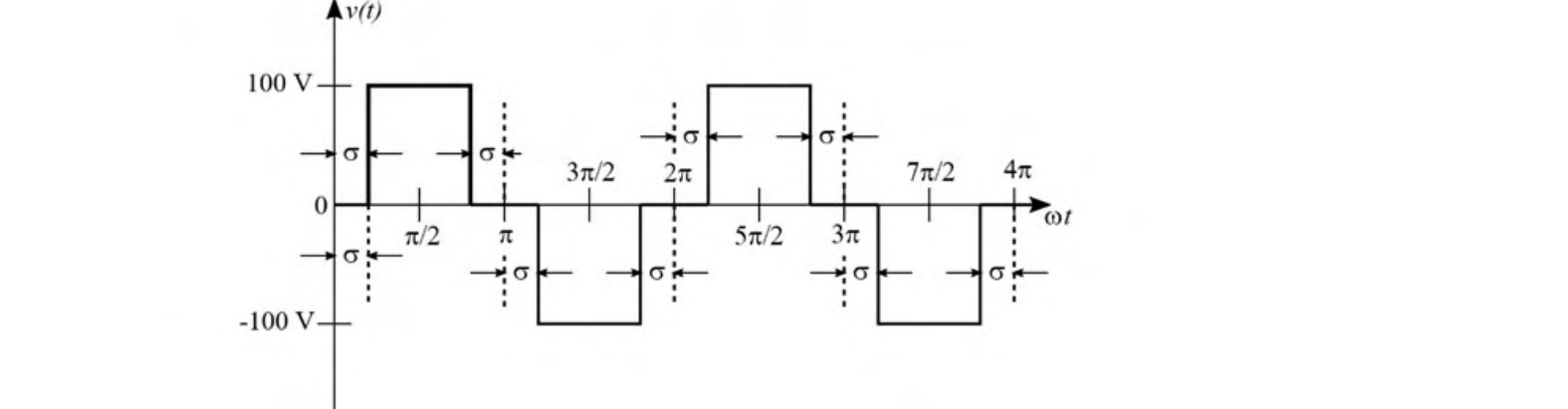
A single-phase inverter is fed from a 100 V dc source and is controlled using a quasi-square wave modulation scheme to produce an output waveform, $v(t)$, as shown. The angle $\sigma$ is adjusted to entirely eliminate the third harmonic component from the output voltage. Under this condition, for $v(t)$, the magnitude of the 5th harmonic component as a percentage of the magnitude of the fundamental component is ________ (rounded off to 2 decimal places).
For this quasi-square wave the $n$th harmonic is proportional to $\frac{\cos n\sigma}{n}$. The third harmonic vanishes when $\cos3\sigma=0$, i.e. $\sigma=30^\circ$. Then $\frac{|V_5|}{|V_1|}=\frac{|\cos150^\circ|/5}{\cos30^\circ}=\frac15=20\%$.
More Single-phase and three-phase voltage and current source inverters, sinusoidal pulse width modulation questions
GATE 2019 EE Q35– The output voltage of a single-phase full bridge voltage source inverter is controlled by…
GATE 2016 EE Q54– The switches T1 and T2 in Figure (a) are switched in a complementary fashion with…
GATE 2016 EE Q60– A single-phase full-bridge voltage source inverter (VSI) is fed from a 300 V battery. A…
GATE 2015 EE Q43– The single-phase full-bridge voltage source inverter (VSI), shown in figure, has an output…
GATE 2017 EE Q34– In the converter circuit shown below, the switches are controlled such that the load…
GATE 2017 EE Q35– A 3-phase voltage source inverter is supplied from a 600 V DC source as shown in the…