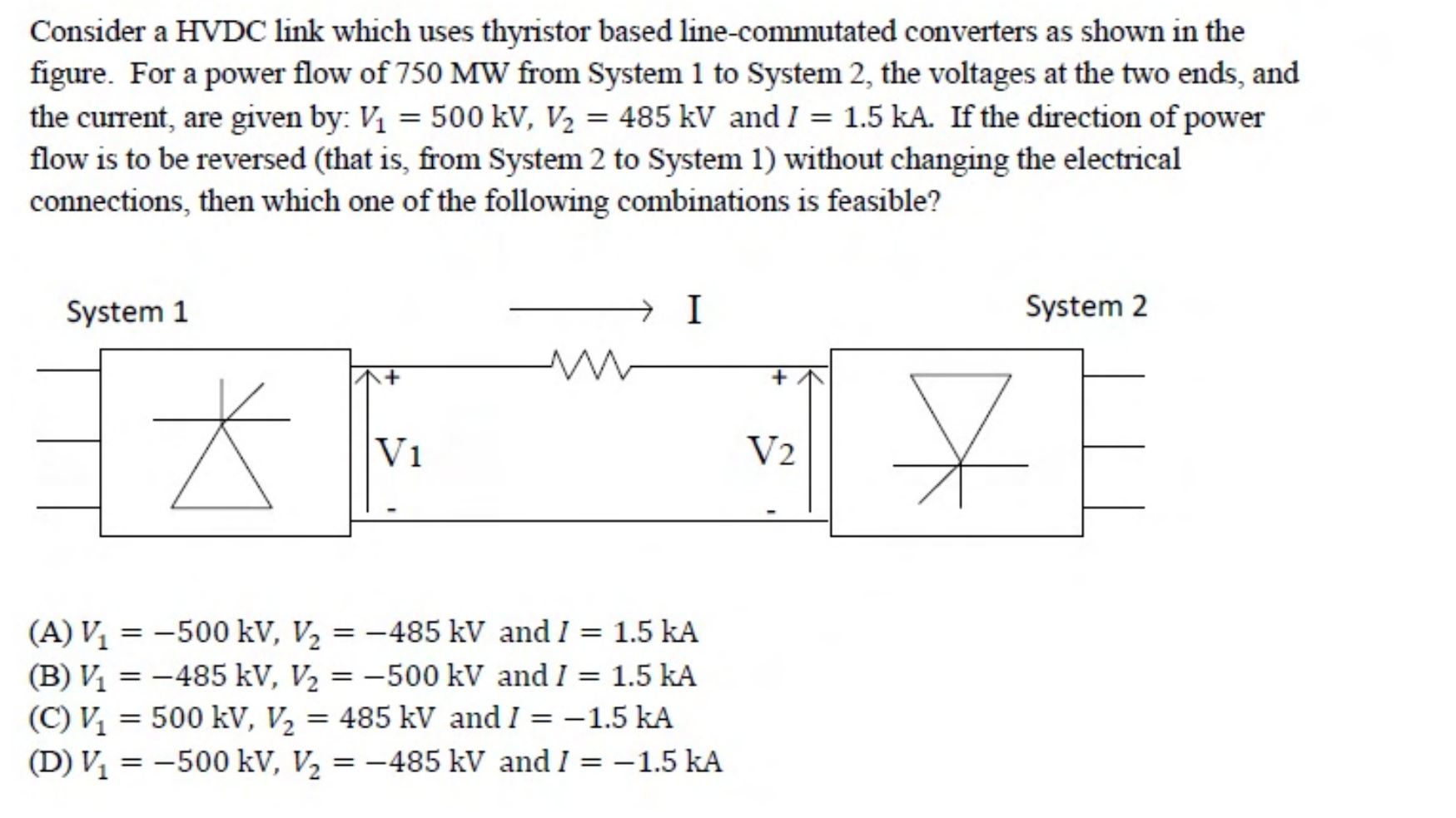
Consider a HVDC link which uses thyristor based line-commutated converters as shown in the figure. For a power flow of 750 MW from System 1 to System 2, the voltages at the two ends, and the current, are given by: $V_1 = 500$ kV, $V_2 = 485$ kV and $I = 1.5$ kA. If the direction of power flow is to be reversed (that is, from System 2 to System 1) without changing the electrical connections, then which one of the following combinations is feasible?
$V_1 = -500$ kV, $V_2 = -485$ kV and $I = 1.5$ kA
$V_1 = -485$ kV, $V_2 = -500$ kV and $I = 1.5$ kA
$V_1 = 500$ kV, $V_2 = 485$ kV and $I = -1.5$ kA
$V_1 = -500$ kV, $V_2 = -485$ kV and $I = -1.5$ kA
Correct answer: (B) $V_1 = -485$ kV, $V_2 = -500$ kV and $I = 1.5$ kA
Explanation
Thyristors conduct current in one direction only, so the current $I$ cannot reverse, which rules out C and D. Power can be reversed by reversing the voltage polarities. For power to flow from System 2 to System 1, the sending end (System 2) must be at the higher voltage magnitude with the line current still positive. That gives $V_1 = -485$ kV and $V_2 = -500$ kV, so System 2 delivers $500 \times 1.5 = 750$ MW and System 1 absorbs $485 \times 1.5$ MW, with the difference lost in the line.
More Basic concepts of electrical power generation, AC and DC transmission concepts, Models and performance of transmission lines and cables questions
GATE 2015 EE Q27– Base load power plants are P: wind farms. Q: run-of-river plants. R: nuclear power plants.…
GATE 2014 EE (EE2) Q52– Two horizontal conductors of a 50 Hz single-phase line have outer diameter 1.6 cm and…
GATE 2017 EE (EE2) Q34– The nominal-π line model has series impedance Z=10080\ and each shunt branch has…
GATE 2017 EE (EE2) Q61– A balanced 3-phase 50 Hz overhead line has conductors at an equilateral triangle’s…
GATE 2016 EE (EE2) Q50– A no-load lossless three-phase 50 Hz line has sending and receiving line voltages 400 kV…
GATE 2015 EE (EE2) Q51– A composite conductor comprises three identical circular conductors of radius R arranged…