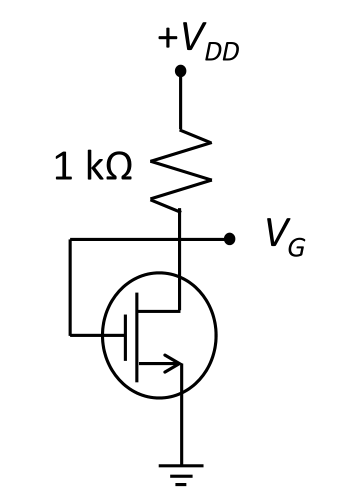
An $n$-channel MOSFET is connected as shown in the Figure. Assume $V_{TH}=1$ V, $V_{DD}=5$ V, and $\mu C_{ox}(W/L)=2$ mA V$^{-2}$ and neglect channel length modulation effects. The gate voltage ($V_G$) of the $n$-channel MOSFET (in Volt) is ________. (rounded off to two decimal places)
The gate is tied to the drain, so $V_{DS}=V_{GS}$ and the transistor is in saturation: $I_D=\dfrac12(2\text{ mA/V}^2)(V_G-1)^2=(V_G-1)^2$ mA.
The resistor equation is $I_D=\dfrac{5-V_G}{1\text{ k}\Omega}$ mA. Setting them equal with $u=V_G-1$: $u^2=4-u$, i.e. $u^2+u-4=0$, so $u=\dfrac{-1+\sqrt{17}}2=1.56$ (the positive root).
$V_G=1+1.56=2.56$ V.
More BJT and MOSFET Amplifiers questions
GATE 2025 EC Q21– A simplified small-signal equivalent circuit of a BJT-based amplifier is given below. The…
GATE 2025 EC Q22– The ideal BJT in the circuit given below is biased in the active region with a of 100. If…
GATE 2025 EC Q30– Which of the following statements is/are TRUE with respect to ideal MOSFET-based…
GATE 2025 EC Q43– The identical MOSFETs M 1 and M 2 in the circuit given below are ideal and biased in the…
GATE 2025 EC Q47– In the circuit shown, the identical transistors Q1 and Q2 are biased in the active region…
GATE 2024 EC Q17– In the circuit below, assume that the long channel NMOS transistor is biased in…