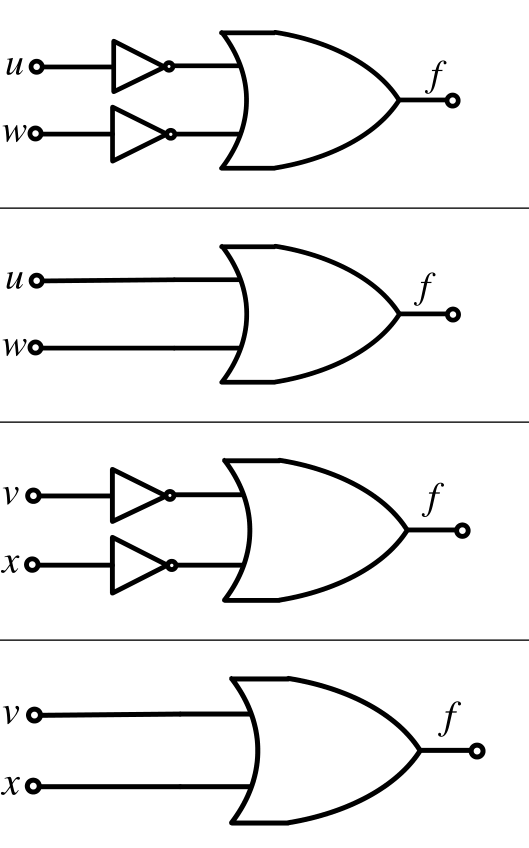
Correct answer: (A) Circuit (A): an OR gate whose inputs are $\bar u$ and $\bar w$
Explanation
Combine the first two factors on $x$: $(\bar u+\bar v+\bar w+\bar x)(\bar u+\bar v+\bar w+x)=\bar u+\bar v+\bar w$. Combine the last two: $(\bar u+v+\bar w+\bar x)(\bar u+v+\bar w+x)=\bar u+v+\bar w$. Their product is $(\bar u+\bar w)+\bar vv=\bar u+\bar w$. That is an OR gate fed by the inverted inputs $u$ and $w$: circuit (A).
More VCOs and timers, combinatorial and sequential logic circuits, multiplexers, demultiplexers questions
GATE 2024 EE Q24– Simplified form of the Boolean function F(P,Q,R,S)= P Q+ PQS+P Q R S+P QR S is
GATE 2024 EE Q25– In the circuit, the present value of Z is 1. Neglecting the delay in the combinatorial…
GATE 2024 EE Q26– To obtain the Boolean function F(X,Y)=X Y+ X, the inputs PQRS in the figure should be (4:1…
GATE 2023 EE Q56– Neglecting the delays due to the logic gates in the circuit shown in figure, the decimal…
GATE 2023 EE Q57– In a given 8-bit general purpose micro-controller there are following flags. C-Carry,…
GATE 2022 EE Q26– A MOD 2 and a MOD 5 up-counter when cascaded together results in a MOD counter. (in…