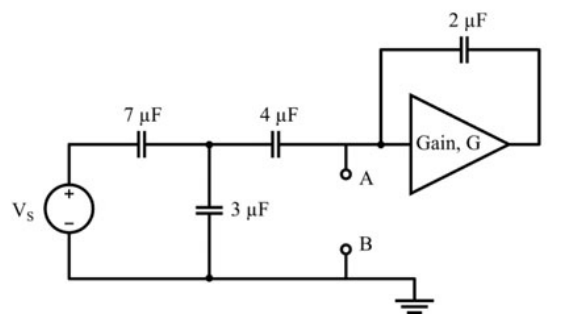
The 2 μF capacitor bridges amplifier input and output. Miller’s theorem gives its input equivalent $C_M=C(1-G)=2[1-(-5)]=12$ μF. For incremental capacitance the ideal DC source is shorted, so 7 μF and 3 μF are parallel, giving 10 μF. That is in series with 4 μF, giving $4(10)/(4+10)=20/7$ μF. The total seen at A is $12+20/7=14.857$ μF, or 14.86 μF.
More Circuit laws and network theorems: Independent, dependent, ideal and practical sources, Kirchhoff's laws, mesh and nodal analysis, star-delta transformation, superposition, Thevenin's, Norton's, Miller's, maximum power transfer and reciprocity theorems questions
GATE 2026 IN Q32– The potential difference between nodes A and B in a circuit is v A-v B=5\ V. The work done…
GATE 2026 IN Q40– In the circuit shown below, the value of the output voltage V 0 is V.
GATE 2023 IN Q31– In the circuit given, the Thevenin equivalent resistance Rth across the terminals ‘a’ and…
GATE 2022 IN Q54– For Circuit A with shown currents I 1,I 2, the current I 3 in Circuit B is A (one decimal…
GATE 2020 IN Q14– The series circuit shown has resistors rated 100 Ω, 1 W; 2 Ω, 0.5 W; and 1 Ω, 0.25 W. Find…
GATE 2020 IN Q40– For mesh currents I₁,I₂,I₃ and source polarities in the circuit shown, which matrix…