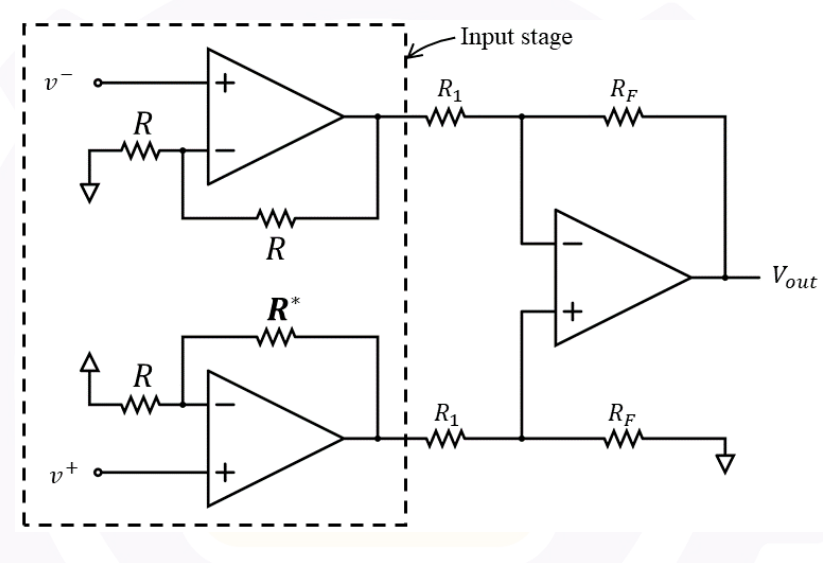
In the ideal instrumentation amplifier shown, one input-stage feedback resistor R* differs slightly from the other input-stage resistors R. Which statements are true?
Correct answer: (A) Mismatch introduces a gain error; (B) Mismatch degrades common-mode rejection ratio
Explanation
One input amplifier has gain two while the other has gain 1+R*/R. Their mismatch changes the differential gain and prevents identical common-mode inputs from producing identical first-stage outputs. The difference stage then converts some common-mode signal into output, degrading CMRR. Ideal op-amps with both inputs zero still give zero output, so mismatch alone creates no input-independent offset. Select A,B.
More Operational Amplifiers questions
GATE 2025 BM Q15– The ideal op-amp circuit shown is driven by Vin=1 V and powered by ±15 V rails. Find Vout…
GATE 2025 BM Q52– Find the ideal summing op-amp output shown, in volts to the nearest integer. Inputs are 2…
GATE 2025 BM Q54– The oscillator shown has R=1 kΩ,R1=2 kΩ,R2=6 kΩ,C=0.1 μF. Find its oscillation frequency…
GATE 2023 BM Q19– In the shown ideal-op-amp circuit, the parallel-plate capacitance is C= A/x, where ε is…
GATE 2023 BM Q51– For the shown ideal-op-amp circuit, which properties are true? The inverting terminal is…
GATE 2022 BM Q41– The op-amp/resistor/capacitor filter shown uses ideal op-amps with infinite gain and…