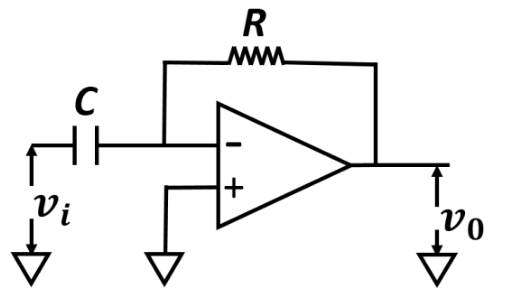
In the shown ideal-op-amp circuit, the parallel-plate capacitance is $C=\varepsilon A/x$, where ε is dielectric permittivity, A is plate area and $x=x_0+kt$ is plate separation. Here t is time and x₀,k are positive nonzero constants. Input vᵢ is constant. What is output v₀?
Virtual ground places the full constant input across the capacitor. Its current is $i=d(Cv_i)/dt=v_i\,dC/dt$. Since $dC/dt=-\varepsilon Ak/x^2=-Ck/x$, the inverting current-to-voltage stage gives $v_0=-Ri=Rv_iCk/x$. Thus A; a variable capacitor can carry current even at constant applied voltage.
More Operational Amplifiers questions
GATE 2023 BM Q51– For the shown ideal-op-amp circuit, which properties are true? The inverting terminal is…
GATE 2022 BM Q41– The op-amp/resistor/capacitor filter shown uses ideal op-amps with infinite gain and…
GATE 2022 BM Q57– The shown ideal op-amp has infinite gain and bandwidth and ±10 V supplies. Inputs 0.1 V…
GATE 2021 BM Q43– All op-amps in the shown circuit are ideal with infinite gain and bandwidth. Find…
GATE 2021 BM Q61– The shown op-amp has ±10 V supplies. Its non-inverting node connects to ground through 2R…
GATE 2020 BM Q38– For Vᵢₙ=10sin(2πt) applied to the circuit shown, which output waveform results? Both…