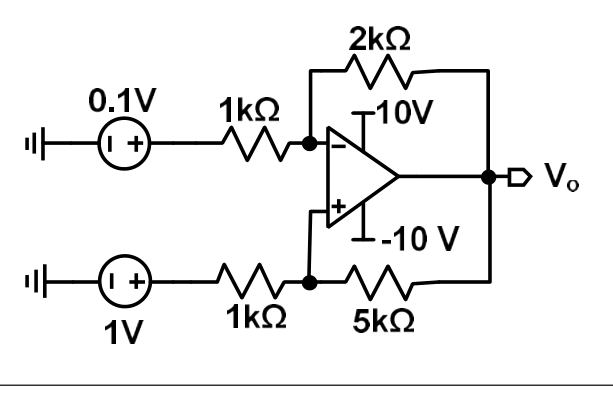
The shown ideal op-amp has infinite gain and bandwidth and ±10 V supplies. Inputs 0.1 V and 1 V connect via 1 kΩ to the inverting and non-inverting terminals respectively. Feedback resistors are 2 kΩ to the inverting node and 5 kΩ to the non-inverting node. Find Vₒ in V to one decimal.
Negative feedback dominates and the output remains within the rails, so both input nodes equal v. KCL at the inverting node gives (v−.1)/1+(v−Vo)/2=0, hence Vo=3v−.2. At the non-inverting node, (v−1)/1+(v−Vo)/5=0, so Vo=6v−5. Equating gives v=1.6 V and Vo=4.6 V.
More Operational Amplifiers questions
GATE 2021 BM Q43– All op-amps in the shown circuit are ideal with infinite gain and bandwidth. Find…
GATE 2021 BM Q61– The shown op-amp has ±10 V supplies. Its non-inverting node connects to ground through 2R…
GATE 2020 BM Q38– For Vᵢₙ=10sin(2πt) applied to the circuit shown, which output waveform results? Both…
GATE 2026 BM Q48– For the ideal op-amp circuit shown, find input impedance looking into Vin.
GATE 2026 BM Q55– In the ideal instrumentation amplifier shown, one input-stage feedback resistor R* differs…
GATE 2025 BM Q15– The ideal op-amp circuit shown is driven by Vin=1 V and powered by ±15 V rails. Find Vout…