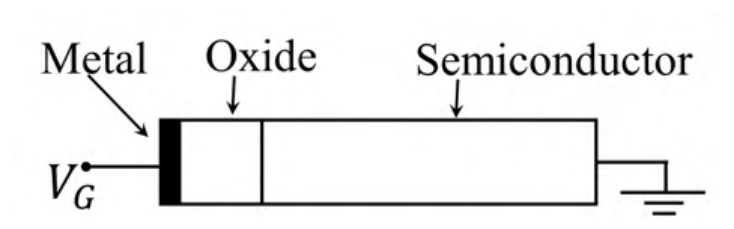
An ideal MOS capacitor ($p$-type semiconductor) is shown in the figure. The MOS capacitor is under strong inversion with $V_G=2$ V. The corresponding inversion charge density ($Q_{IN}$) is $2.2\ \mu\text{C/cm}^2$. Assume oxide capacitance per unit area as $C_{ox}=1.7\ \mu\text{F/cm}^2$. For $V_G=4$ V, the value of $Q_{IN}$ is ________ $\mu\text{C/cm}^2$ (rounded off to one decimal place).
In strong inversion, any extra gate voltage is balanced by extra inversion charge (the depletion width has reached its maximum), so $\Delta Q_{IN}=C_{ox}\,\Delta V_G$.
Raising $V_G$ from 2 V to 4 V adds $1.7\times(4-2)=3.4\ \mu\text{C/cm}^2$, so $Q_{IN}=2.2+3.4=5.6\ \mu\text{C/cm}^2$.
More P-N Junction and Semiconductor Devices questions