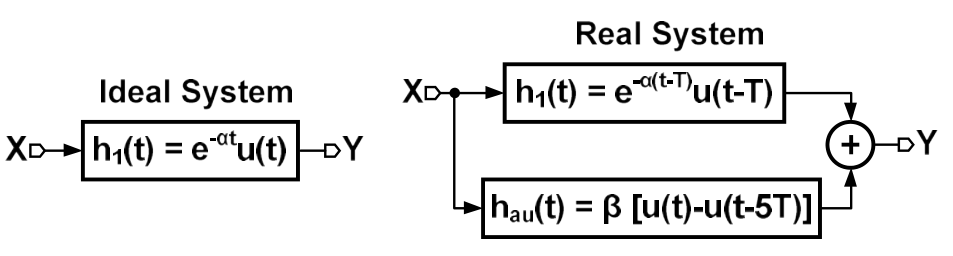
The ideal system has $h_i(t)=e^{-\alpha t}u(t)$. The real system has delayed response $h_r(t)=e^{-\alpha(t-T)}u(t-T)$ plus auxiliary path $h_a(t)=\beta[u(t)-u(t-5T)]$. For impulse input, choose β so the outputs agree at t=4T.
At four T, the ideal output is e⁻⁴ᵅᵀ, the delayed output e⁻³ᵅᵀ, and the auxiliary rectangular path contributes β. Thus β=e⁻⁴ᵅᵀ−e⁻³ᵅᵀ=−e⁻³ᵅᵀ(1−e⁻ᵅᵀ), C. This negative correction removes the excess caused by the delay.
More LTI Systems and Convolution questions
GATE 2021 BM Q40– The shown x[n] and h[n] are convolved to give y[n]. If y[2]=1 and y[3]=0, find h[0]. The…
GATE 2026 BM Q63– An LTI system has h[n]=[0,0.6,0.8,0.5,0.3,0] and input x[n]=[1,0.6,0,0,0,0], both indexed…
GATE 2025 BM Q44– Systems U,V are defined by U: y(t)=x(t)²+1 and V: y(t)=x(t+1). Which are correct?
GATE 2025 BM Q47– An LTI system has h[n]=δ[n]+δ[n−1]/2+δ[n−2]/3. Input is x[n]=δ[n]+δ[n−1]. Which output…
GATE 2024 BM Q24– An LTI system obeys y(t)+y′(t)+0.5y″(t)=x(t)+0.1x′(t). Find the Laplace transform of its…
GATE 2024 BM Q59– x[n]=u[n]−u[n−5],h[n]=δ[n]−δ[n−1],and y=x*h. Find the sum of y[n] over all integers n, as…