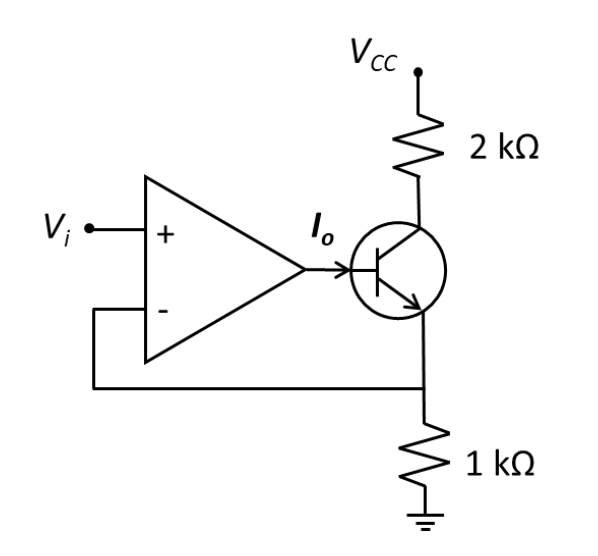
Consider the circuit shown in the Figure with $V_i = 3$ V and $V_{CC} = 12$ V. Assume $V_{BE}=0.7$ V and $\beta_{dc}=99$ for the BJT. Which of the following options is the correct value of the current $I_o$?
The op-amp forces the emitter voltage to equal $V_i=3$ V (virtual short between its inputs, with the emitter fed back to the inverting input).
$I_E=\dfrac{3\text{ V}}{1\text{ k}\Omega}=3$ mA. The op-amp output supplies the base current $I_o=I_B=\dfrac{I_E}{\beta+1}=\dfrac{3\text{ mA}}{100}=30\ \mu$A.
More BJT and MOSFET Amplifiers questions
GATE 2026 EC Q50– A small signal source, V i(t)=A(105t)+B(107t) is applied to a BJT circuit as shown in the…
GATE 2026 EC Q60– An n-channel MOSFET is connected as shown in the Figure. Assume V TH=1 V, V DD=5 V, and C…
GATE 2025 EC Q21– A simplified small-signal equivalent circuit of a BJT-based amplifier is given below. The…
GATE 2025 EC Q22– The ideal BJT in the circuit given below is biased in the active region with a of 100. If…
GATE 2025 EC Q30– Which of the following statements is/are TRUE with respect to ideal MOSFET-based…
GATE 2025 EC Q43– The identical MOSFETs M 1 and M 2 in the circuit given below are ideal and biased in the…