The GATE Grind

GATE 2016 EC – Question 25

Analog Circuits · Op-amp Circuits · 1 mark · Multiple choice

Consider the oscillator circuit shown in the figure. The function of the network (shown in dotted lines) consisting of the 100 kΩ resistor in series with the two diodes connected back-to-back is to:
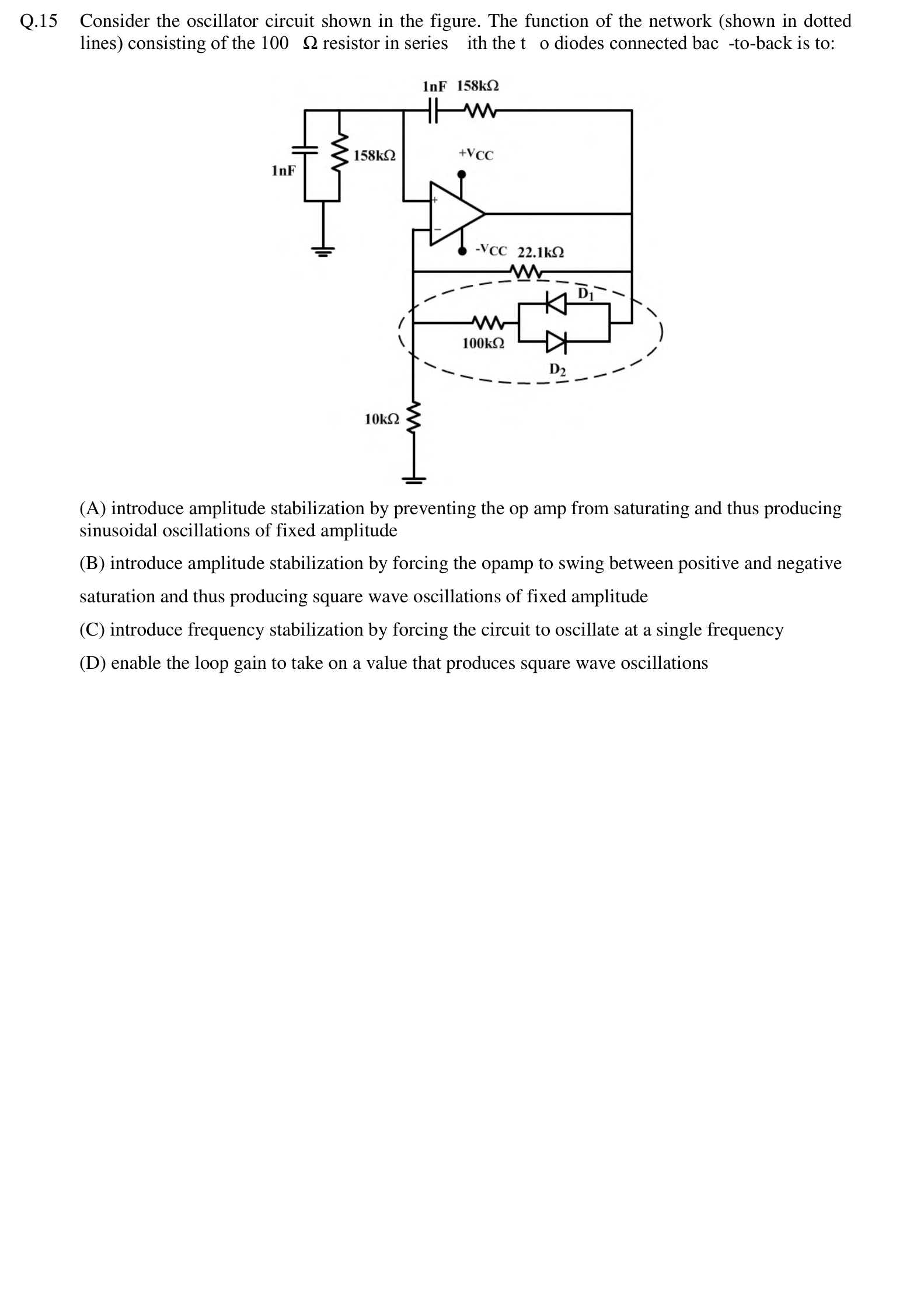
A Wien bridge oscillator built around an op-amp, with a 1 nF capacitor and 158 kΩ resistor in the positive feedback network. The negative feedback network has a 10 kΩ resistor to ground and a 22.1 kΩ feedback resistor, in parallel with a 100 kΩ resistor in series with two diodes D1 and D2 connected back-to-back.
  1. introduce amplitude stabilization by preventing the op amp from saturating and thus producing sinusoidal oscillations of fixed amplitude
  2. introduce amplitude stabilization by forcing the opamp to swing between positive and negative saturation and thus producing square wave oscillations of fixed amplitude
  3. introduce frequency stabilization by forcing the circuit to oscillate at a single frequency
  4. enable the loop gain to take on a value that produces square wave oscillations

Practise this question in The GATE Grind →

Show answer and explanation

Correct answer: (A) introduce amplitude stabilization by preventing the op amp from saturating and thus producing sinusoidal oscillations of fixed amplitude

Explanation

When the output amplitude grows, the back-to-back diodes begin to conduct and place the 100 kΩ resistor in parallel with the feedback resistor, which lowers the loop gain. This limits the amplitude before the op-amp saturates, so the oscillator gives a sine wave of steady amplitude.